Juniper Networks JNP-QSFP-AOCBO-25M Compatible 40G QSFP+ to 4 x 10G SFP+ Active Optical Breakout Cable, 25m (82ft)
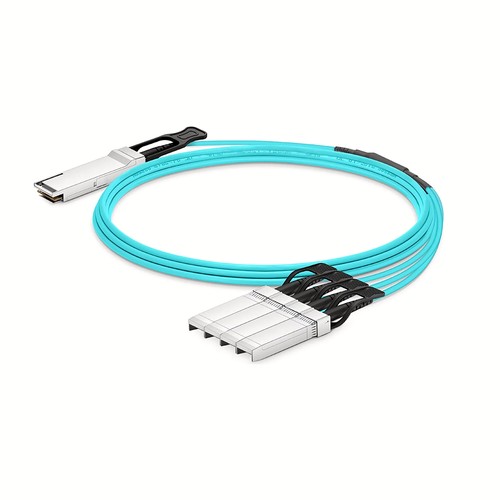
For project documentation, Juniper Networks JNP-QSFP-AOCBO-25M and this cable’s physical length should be recorded together. The product described here is a 25m (82ft) AOC assembly for 40G links, using QSFP+ to 4 SFP+. Its OEM cross-reference, HT part number, specification table and packing options support traceable ordering and installation records.
OEM Part Number: JNP-QSFP-AOCBO-25MHT Part Number: JNP-QSFP-AOCBO-25M
Product Highlights
- Compatible alternative to Juniper Networks JNP-QSFP-AOCBO-25M
- 40G connectivity at 40Gbps
- Interface configuration: QSFP+ to 4 SFP+
- Fixed length and part number: 25m (82ft), JNP-QSFP-AOCBO-25M
- Minimum bend radius: 30mm
Specifications
| HT Part Number | JNP-QSFP-AOCBO-25M |
|---|---|
| Juniper Networks Compatible | JNP-QSFP-AOCBO-25M |
| Manufacturer | HT |
| Connector Type | QSFP+ to 4 SFP+ |
| Data Rate | 40Gbps |
| Minimum Bend Radius | 30mm |
| Cable Length | 25m (82.02ft) |
| Jacket Material | OFNP |
| Temperature | 0 to 70°C (32 to 158°F) |
| Protocols | 10G/40Gigabit Ethernet or Fibre Channel |
Juniper Deployment Reference
Juniper platform documentation distinguishes straight QSFP28 DAC or AOC connections from DACBO and AOCBO breakout operation. On channelized systems, the host port must be configured for the required breakout mode. Match this HT compatible cable to the exact Juniper part number and the intended platform configuration.
Breakout Port Mapping
The QSFP+ to 4 SFP+ configuration divides the high-speed interface into multiple lower-speed connections. Verify the upstream lane assignment, downstream port speeds and breakout setting on the host before connecting the assembly. Each branch must attach to the correct remote interface.
Integrated Optical Assembly
The optical engines and fiber are permanently integrated into this AOC. There are no detachable optical modules to clean or exchange. Handle the complete assembly by its connector housings and cable, and keep both ends matched to the same interface specification.
Length Selection and Installation Planning
A 25m (82ft) run can remain tidy when its pathway and service allowance are planned together. Keep the integrated optical cable and both optical engines away from tight cable-tie pressure, verify bend control at changes of direction and ensure that neither port supports the assembly’s weight. Record the exact order code after acceptance. Within this family, JNP-QSFP-AOCBO-20M is shorter at 20m (66ft), while JNP-QSFP-AOCBO-30M is the next longer choice at 30m (98ft); comparing those two boundaries helps avoid both tension and unnecessary slack.
Position Within the Length Range
JNP-QSFP-AOCBO-25M occupies the middle of this family between JNP-QSFP-AOCBO-20M at 20m (66ft) and JNP-QSFP-AOCBO-30M at 30m (98ft). It adds 5m over the shorter option for extra routing clearance, while the next longer version adds another 5m. Measure the managed path and choose this version when its reach is sufficient without creating the slack associated with the longer assembly.
Project Documentation and Cable Identification
Large deployments are easier to audit when the order code, physical length and endpoint record agree. Keep the OEM reference in the compatibility document and use the HT part number on the packing list. Where several lengths arrive together, labels and carton groups can be arranged by rack or port plan so installers do not have to identify cables by appearance alone. For this assembly, the minimum bend radius is 30mm; the jacket material is OFNP.
Cable Construction and Routing
This assembly uses OFNP jacket, minimum bend radius 30mm. These mechanical characteristics affect how the cable should be dressed behind the equipment. Avoid sharp edges, excessive ties and repeated tight bends close to the connector boots.
Network and Protocol Considerations
The intended application is determined by the host interface and protocol support. Listed interface and protocol references include 10G/40Gigabit Ethernet or Fibre Channel. Confirm that the host firmware and port configuration support the same operating mode.
Juniper Networks Compatibility and Factory Testing
Factory verification links the compatibility identity to the exact physical assembly described on this page. Identification, connector condition and live link behavior are checked before packing. Customers can submit equipment and firmware details with the project documentation for a more specific pre-order compatibility review. Where supported by the host, receive activity and diagnostic indications are reviewed together with the established link.
Frequently Asked Questions
Is this an original Juniper Networks cable?
No. It is an HT-manufactured compatible alternative for equipment that specifies Juniper Networks JNP-QSFP-AOCBO-25M.
What details assist a compatibility review?
Provide the equipment manufacturer, model, port type, hardware revision and software release, together with the OEM reference, required length and quantity.
How should an unused assembly be stored?
Protect both connector ends, keep the cable in a loose bend-safe coil and retain its part-number label so the length and compatibility identity remain traceable.
Can different brands be connected with the same assembly?
Only where both hosts explicitly support the complete interface and compatibility arrangement. Document each end and select the appropriate brand-specific product when required.
Ordering Information
Use the listed HT part number for ordering and retain the OEM reference as the host-compatibility cross-reference. Send quantities by length, along with any rack-based packing or label instructions. If the project has mixed equipment, include the host model for each group rather than relying only on the aggregate cable rate. This page’s fixed configuration is 25m (82ft); another length must be quoted under its corresponding part number.
Shipping and Lead Time
Standard configurations normally ship within one to three working days, while production quantities are confirmed with the order. Delivery can be arranged by courier, air freight or sea freight, and goods may instead be handed to an appointed forwarder or shipped on the customer’s courier account.
Quality Assurance and Packaging
Inspection and link testing are completed before the cable enters its protective packaging. Project orders can be packed and labelled by length, rack or customer reference, with packing documentation that makes received quantities straightforward to reconcile against the installation schedule. Volume orders can include customer references on the labels and carton list.


