LC to SC Duplex FTTA Outdoor Patch Cable, OS2, 7.0mm LSZH
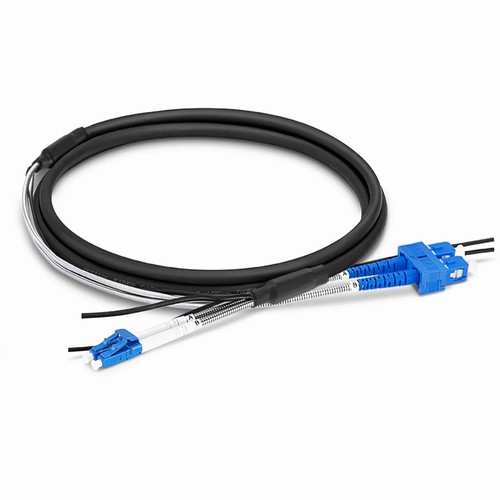
For Pakistani procurement and engineering teams, the specification provides a practical basis for checking compatibility before production is requested. This duplex FTTA patch cable bridges the optical interface gap between generations of base station hardware: LC UPC duplex on one end for the small-form-factor ports on current baseband units and radios, SC UPC duplex on the other for the installed equipment, frames and enclosures that still present SC interfaces. The installed cable itself is the standard FTTA outdoor build: two OS2 9/125µm single-mode fibers of Corning G.657.A1 glass in a 7.0mm LSZH jacket, with helical steel armored branches protecting the tails at the two interfaces.
Product Highlights
- Helical steel armored branches, anti-rodent and bird-proof
- Stock lengths 3m to 50m; project lengths on request
- LC UPC to SC UPC duplex, OS2 9/125µm single mode
- Hybrid connector mix for mixed-generation equipment
- Corning G.657.A1 bend-insensitive fiber, 20/10D bend radius
- 7.0mm LSZH UV-stabilized outdoor jacket
Specifications
| Connector Type | LC to SC |
|---|---|
| Polish Type | UPC to UPC |
| Fiber Mode | OS2 9/125µm |
| Wavelength | 1310/1550nm |
| Fiber Count | Duplex / 2 Fibers |
| Fiber Grade | Corning G.657.A1 |
| Min. Bend Radius (Fiber Cable) | 20/10D (Dynamic/Static) |
| Attenuation at 1310nm | ≤0.36dB/km |
| Attenuation at 1550nm | ≤0.22dB/km |
| Cable Jacket | Low Smoke Zero Halogen (LSZH) |
| Cable Diameter (Outer/Inner) | 7.0/2.0mm |
| Armored Breakout Length (End A/B) | 0.03/0.34m |
| Tensile Strength | 200/400N (Long/Short Term) |
| Crush Resistance | 1100/2200N (Long/Short Term) |
| Insertion Loss | ≤0.3dB |
| Return Loss | ≥50dB |
| Operating Temperature | -20 to 70°C (-4 to 158°F) |
| Storage Temperature | -40 to 80°C (-40 to 176°F) |
Why a hybrid LC to SC cord exists
Base station sites evolve in stages. A shelter upgraded with new baseband hardware presents LC ports, whereas the outdoor enclosure, the fiber distribution frame or the surviving radio hardware may still be SC. Replacing each SC interface is rarely economical; a hybrid jumper with factory-prepared LC and SC ends solves the transition cleanly. The two connectors are polished and tested in the factory, and therefore the mixed interface adds no field termination and no supplementary loss beyond the rated 0.3dB per connector.
Outdoor construction for the whole route
Whether the SC end lands in an outdoor cabinet or the LC end climbs to the radio, the whole cord is built to the identical outdoor standard: a 7.0mm LSZH jacket with UV stabilization, aramid strength members, and helical steel armored branches over the two tails. The terminated assembly tolerates vertical hanging runs, wind-induced flexing and the temperature swings of an exposed structure, with an operating range from -20 to 70 degrees Celsius.
Bend-insensitive glass at both ends
Enclosures that accept SC connectors are frequently older and tighter inside than modern hardware. G.657.A1 fiber tolerates the 10D static bends that appear when a duplex cord is dressed into a crowded box, holding attenuation steady where legacy G.652.D glass would begin to leak light. Compatibility with the current single-mode plant is unaffected, and therefore the hybrid cord drops into the present power budget.
Planning the connector orientation
On a hybrid cord it is worth stating explicitly which end goes where: LC toward the baseband or radio port, SC toward the frame or enclosure. Identification the two legs at the factory avoids crossed connections during commissioning, and the breakout lengths at every end can also be matched to the actual hardware positions so neither tail carries strain or excess slack.
Standard and custom length options
Catalogue lengths are stocked for fast delivery: 3m (10ft), 5m (16ft), 10m (33ft), 20m (66ft), 30m (98ft) and 50m (164ft), covering the common shelter-to-tower and frame-to-radio runs this cord is built for. Special lengths beyond this range are manufactured to order. For mixed-hardware sites, record which end of the path is LC and which is SC jointly with the length; the orientation is built into the terminated assembly and cannot be reversed in the field. Specifying the precise path length avoids the two the slack storage problem of an overlong cord and the strain risk of one that is too short.
Test standards and quality control
The two the LC and the SC terminations are factory polished and optically tested: insertion loss is verified against the 0.3dB ceiling and return loss against the 50dB minimum on every fan-out leg. End-face geometry is inspected on every installed connector, and the completed cord is checked as a whole unit so it can also be plugged into service without on-site rework.
Ordering Details and Factory Support
Refer to the LC-SC duplex FTTA series when specifying a quotation and state the path length jointly with the project-specific connector orientation. Other connector mixes, including FC and ST, are covered by the custom-built duplex FTTA program on the identical outdoor platform; send the specification with the request and the factory will make certain of the manufacturable specification before factory assembly. For Pakistan, a clear port or maintenance schedule helps us confirm the correct factory-built configuration before supply.


