LC UPC to LC UPC Duplex OS2 OFNR 24F Indoor Breakout Cable
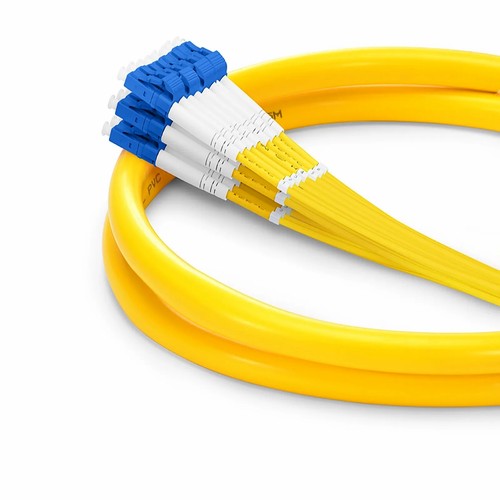
For Pakistani procurement and engineering teams, the specification provides a practical basis for checking compatibility before production is requested. This pre-terminated breakout cable delivers an entire 24-fiber indoor connection in one factory-built unit: an OS2 single-mode trunk on a riser (OFNR) jacket opens into duplex LC UPC legs at every end, each leg optically tested before packing. It replaces a full day of field termination with a single plug-in installation.
Product Highlights
- Optical Testing Ensures Network Performance
- Riser (OFNR) Flame-retardant Jacket
- Precision Zirconia Ferrule Connectors Ensure Low Loss
- Duplex Clip Prevents the Fiber from Rotating and Maintains the Polarity
- G.657.A1 Bend Insensitive Fiber & 10mm Min. Bend Radius
Specifications
| Connector Type | LC Duplex |
|---|---|
| Polish Type | UPC |
| Fiber Mode | OS2 9/125μm |
| Wavelength | 1310/1550nm |
| Fiber Count | 24 Fibers |
| Cable Jacket | Riser (OFNR) |
| Fiber Grade | G.657.A1 |
| Minimum Bend Radius | 20/10D (Dynamic/Static) |
| Insertion Loss | ≤0.3dB |
| Return Loss | ≥50dB |
| Attenuation at 1310nm | 0.36 dB/km |
| Attenuation at 1550nm | 0.22 dB/km |
| Breakout Outside Diameter (OD) | 2.0mm |
| Trunk Outside Diameter (OD) | 15.0-16.0mm |
| Breakout Type | 0.5m Equal Breakout |
| Polarity (Duplex) | A (Tx) to B (Rx) |
| Operating Temperature | -10 to 60°C (14 to 140℉) |
| Storage Temperature | -20 to 70°C (-4 to 158°F) |
Bend-insensitive glass in real pathways
Backbone routes turn through tight tray corners, congested risers and crowded vertical channels. Because the G.657.A1 bend-insensitive fiber in the product assembly tolerates a 10mm fiber bend radius, a hurried routing decision during a night servicing window does not by itself turn into a measurable penalty on the connection. The glass remains fully compatible with the G.652.D plant it connects to.
Single-mode trunks for building and campus backbones
A pre-terminated OS2 trunk carries the links that leave the room: riser spans between floors, campus backbones between buildings and each wavelength-multiplexed service in between. Because the glass is the identical group used in the outside plant, the terminated assembly does not by itself become the weak point of the optical loss calculation. At 1310 and 1550nm the attenuation stays a fraction of a decibel per kilometer, and every factory-polished connector adds less than 0.3dB when the end faces are clean and seated.
A complete 24-fiber link in one assembly
Twenty-four fibers is the practical size for a row feed or a floor distribution connection: sufficient lanes for a full panel with spares, still light sufficient for two technicians to path without mechanical help. Factory termination means each one of the 48 connector end faces is polished, inspected and tested before the installed cable ships, a level of consistency that field termination on a ladder rarely reaches.
Duplex legs for duplex optics
Since the optics they serve are duplex: transmit and receive travel jointly from trunk to port, the legs are built as duplex pairs. Because polarity is fixed at the factory and verified before packing, the installer dresses every pair into its port without a second thought about crossover.
Riser jacket for the vertical route
The riser (OFNR) jacket is the rating that lets the product assembly run vertically between floors without a conduit of its own. Because the tight-buffered build inside keeps every fiber individually protected, the trunk assembly tolerates the handling of a riser pull and the dressing inside the floor distributor. For routes that leave the riser-rated pathway, the custom-built versions of this series carry LSZH and plenum options.
From row feed to floor distribution
The natural homes of a 24-fiber duplex-leg trunk are the feeds that terminate as ports: a row of twelve duplex server or switch links, a floor distributor feeding twelve work-region outlets, or a building entrance splitter shelf. In every case the arithmetic is the identical - one pull, one dressing operation, twelve tested duplex links - and the alternative is twelve discrete patch cords with twelve times the pathway fill and twelve times the identification effort.
Planning a trunk route
A multi-fiber trunk is planned once and current once, and therefore the planning deserves the hour it takes. Measure the path through the actual containment, note the bend space at the two interfaces, and decide which end gets pulled. State the pulling eye specification with the order if the path is long or congested. At the far end, leave the dressing slack this adapter panel or cassette needs - the datasheet breakout lengths are the default, and other geometries are confirmed before factory assembly.
Fiber Count Configurations
This build is built with 24 Fibers per trunk, terminated and tested as an entire unit.
Route Length and Custom Builds
Catalogue lengths cover the common routes: 2m (7ft), 10m (33ft), with custom-built length offered beyond the list, including foot-based builds for projects specified in imperial units. Specifying the measured path length keeps the slack out of the tray and the strain off the optical interfaces.
Test Standards and Quality Control
Each trunk is terminated with precision zirconia ferrule connectors and optically tested leg by leg before packing: insertion loss and return loss are verified on every fiber, and end-face geometry is inspected for consistent physical contact. The terminated assembly ships with dust caps on every installed connector and the test results offered on specify.
Ordering Details and Factory Support
Refer to this setup by fiber mode, fiber count, connector pair, breakout geometry and length when specifying a quotation. For configurations outside the listed options - mixed connector families, jacket ratings, pulling eye, identification or project packing - send the specification with the request and the factory will make certain of the build before factory assembly. For Pakistan, a clear port or maintenance schedule helps us confirm the correct factory-built configuration before supply.


