MDC UPC to LC UPC Duplex Push-Pull Boot Uniboot OS2 Fiber Patch Cable
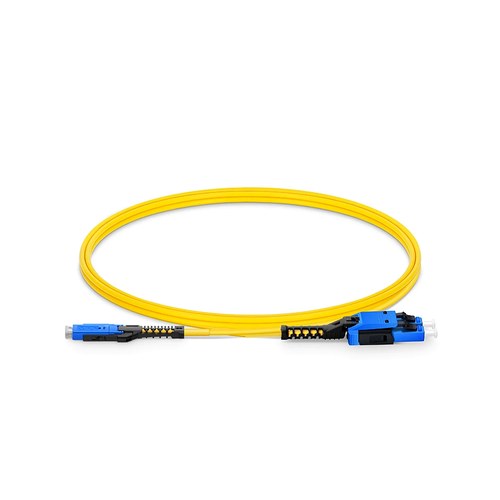
For Pakistani procurement and engineering teams, the specification provides a practical basis for checking compatibility before production is requested. This OS2 fiber patch cable carries a MDC UPC interface on one end and a LC UPC interface on the other, factory terminated on OS2 glass and optically tested as an entire unit. The uniboot build places the two fibers of the duplex connection inside a single round 2.0mm cord with one combined connector housing, halving the installed cable count in dense panels and simplifying polarity management.
Product Highlights
- Uniboot Allows One Cable to Carry Two Fibers to Reduce Cable Congestion in High Density Patch Fields
- G.657.A1 & 10mm Min. Bend Radius
- 3x Fiber Cabling Density over Duplex LC, Providing 432 Fibers within 1 RU
- DirectConec™ Push-pull Boot for Effortless Connector Insertion and Extraction
- Simple Polarity Reversal with No Exposed Fibers
Specifications
| Connector A | US Conec MDC UPC Uniboot |
|---|---|
| Connector B | LC UPC Uniboot |
| Insertion Loss | ≤0.3dB |
| Return Loss | ≥50dB |
| Fiber Mode | OS2 9/125μm |
| Wavelength | 1310/1550nm |
| Attenuation at 1310nm | ≤0.4dB/km |
| Attenuation at 1550nm | ≤0.3dB/km |
| Fiber Grade | G.657.A1 |
| Fiber Count | Duplex |
| Cable Outside Diameter (OD) | 2.0mm |
| Tensile Strength | (Long/Short Term) |
| Polarity | A (Tx) to B (Rx) |
| Operating Temperature | -10 to 70°C (14 to 158℉) |
| Storage Temperature | -20 to 70℃ (-4 to 158℉) |
Bend tolerance in real cabinets
Patch fields are rarely kind to fiber. Patch cords path through tight managers, sharp tray corners and crowded vertical channels. The bend-insensitive glass in the product assembly tolerates a 10mm fiber bend radius, and therefore a hurried routing decision during a night servicing window does not by itself turn into a measurable penalty on the connection.
Where single-mode jumpers earn their place
Single-mode patching carries the links that leave the room: campus backbones, carrier handoffs, long runs between buildings and each wavelength-multiplexed service. Because the OS2 glass in the product assembly is the identical group used in the outside plant, the optical jumper does not by itself become the weak point of the optical loss calculation. At 1310 and 1550nm the attenuation stays a fraction of a decibel per kilometer, and the optical interface pair adds less than 0.3dB when the end faces are clean and seated.
One cord, two fibers
The uniboot design merges the duplex pair into a single round cord and a single connector housing. In a 400G row where each QSFP-DD port consumes a duplex connection, halving the cord count visibly changes the airflow and the manageability of the patching field.
Length Options
Catalogue lengths cover the common patching routes: 1m (3ft), 2m (7ft), 3m (10ft), 5m (16ft), with custom-built length offered beyond the list. Specifying the measured path length keeps the slack out of the manager and the strain off the optical interfaces.
Quality Control and Testing
Every manufactured assembly is terminated with precision zirconia ferrule connectors and optically tested before packing: insertion loss and return loss are verified on every cable, and end-face geometry is inspected for consistent physical contact. The installed cable ships with dust caps on the two connectors and the test result offered on specify.
Ordering and Factory Support
Refer to this setup by connector pair, fiber mode and length when specifying a quotation. For configurations outside the listed options, mixed connector families, jackets, identification or project packing, send the specification with the request and the factory will make certain of the build before factory assembly. For Pakistan, a clear port or maintenance schedule helps us confirm the correct factory-built configuration before supply.


