QSFP28 to QSFP28-100G-DAC-9M29FT 100G QSFP28 4 x 25G NRZ Active Copper Twinax Cable, 9m (29ft)
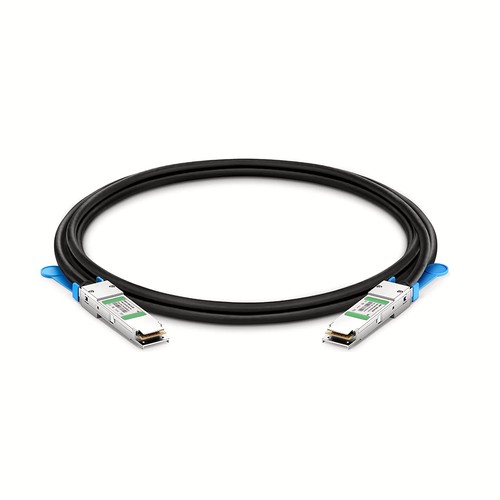
The assembly listed here is the 9m (29ft) member of the QSFP28 to QSFP28-100G-DAC-9M29FT product family for Generic equipment. It provides 100G DAC connectivity through QSFP28 to QSFP28. Project teams can use the detailed table, related references and documentation-oriented packing information to keep each delivered cable aligned with its planned endpoints.
OEM Part Number: QSFP28 to QSFP28-100G-DAC-9M29FTHT Part Number: QSFP28 to QSFP28-100G-DAC-9M29FT
Product Highlights
- HT-manufactured DAC assembly in 9m (29ft)
- 100G connectivity at 100Gbps
- Interface configuration: QSFP28 to QSFP28
- Fixed length and part number: 9m (29ft), QSFP28 to QSFP28-100G-DAC-9M29FT
- Cable construction: Active DAC
- Conductor specification: 26AWG
- Maximum power consumption: 1.5W
- Minimum bend radius: 44.5mm
Specifications
| HT Part Number | QSFP28 to QSFP28-100G-DAC-9M29FT |
|---|---|
| Manufacturer | HT |
| Form Factor | QSFP28 to QSFP28 |
| Max. Data Rate | 100Gbps |
| Media | Copper |
| Cable Type | Active DAC |
| Cable Length | 9m (29ft) |
| Jacket Material | PVC (OFNR) |
| Minimum Bend Radius | 44.5mm |
| Wire AWG | 26AWG |
| Max. Power Consumption | 1.5W |
| Modulation Format | 4x 25G-NRZ to 4x 25G-NRZ |
| Commercial Temperature Range | 0 to 70°C (32 to 158°F) |
| Application | 100G Ethernet |
| Protocols | QSFP28 MSA, SFF-8665 |
Signal and Lane Configuration
The listed modulation format is 4x 25G-NRZ to 4x 25G-NRZ. Both host interfaces must be configured for the same aggregate rate and lane arrangement. A connector that fits mechanically does not by itself guarantee that the remote port supports this encoding or breakout mode.
Passive Copper Operation
A passive DAC has no separate optical conversion stage. Its low-power, low-latency operation is useful for short equipment links, but the assembly must remain within the length and signaling mode accepted by both hosts.
Length Selection and Installation Planning
Choose QSFP28 to QSFP28-100G-DAC-9M29FT when the measured managed path justifies 9m (29ft), not simply to leave a large spare coil. Additional reach can simplify adjacent-rack routing, yet unused cable still needs bend-safe storage and ventilation clearance. Keep identification visible so this extended version is not confused with shorter spares. The next shorter verified assembly is QSFP28 to QSFP28-100G-DAC-7M23FT at 7m (23ft), which is the better comparison when the managed route leaves substantial unused cable.
Position Within the Length Range
QSFP28 to QSFP28-100G-DAC-9M29FT is the longest of 2 verified length options in this family. Compared with QSFP28 to QSFP28-100G-DAC-7M23FT at 7m (23ft), it provides 2m of additional reach for a longer vertical drop, a wider rack or an adjacent-cabinet route. Confirm that the complete path requires this length, because unused slack still needs supported, bend-safe storage.
Project Documentation and Cable Identification
Large deployments are easier to audit when the order code, physical length and endpoint record agree. Keep the OEM reference in the compatibility document and use the HT part number on the packing list. Where several lengths arrive together, labels and carton groups can be arranged by rack or port plan so installers do not have to identify cables by appearance alone. For this assembly, the listed conductor specification is 26AWG; the minimum bend radius is 44.5mm; the stated power consumption is 1.5W; the jacket material is PVC (OFNR).
Power and Thermal Planning
The rated power consumption is 1.5W. Include this load in the host-port power and thermal budget, especially in densely populated switches. Maintain front-panel clearance and do not bundle the cable so tightly that it obstructs airflow around the connectors.
Cable Construction and Routing
This assembly uses 26AWG conductors, PVC (OFNR) jacket, minimum bend radius 44.5mm. These mechanical characteristics affect how the cable should be dressed behind the equipment. Avoid sharp edges, excessive ties and repeated tight bends close to the connector boots.
Network and Protocol Considerations
The intended application is 100G Ethernet. Listed interface and protocol references include QSFP28 MSA, SFF-8665. Confirm that the host firmware and port configuration support the same operating mode.
Generic Compatibility and Factory Testing
Factory verification links the compatibility identity to the exact physical assembly described on this page. Identification, connector condition and live link behavior are checked before packing. Customers can submit equipment and firmware details with the project documentation for a more specific pre-order compatibility review. Where supported by the host, link stability and diagnostic indications are reviewed together with the established link.
Frequently Asked Questions
Is this an original equipment manufacturer cable?
No. It is manufactured by HT under our own manufacturer identity.
What details assist a compatibility review?
Provide the equipment manufacturer, model, port type, hardware revision and software release, together with the OEM reference, required length and quantity.
How should an unused assembly be stored?
Protect both connector ends, keep the cable in a loose bend-safe coil and retain its part-number label so the length and compatibility identity remain traceable.
Can different brands be connected with the same assembly?
Only where both hosts explicitly support the complete interface and compatibility arrangement. Document each end and select the appropriate brand-specific product when required.
Ordering Information
Use the listed HT part number for ordering and retain the OEM reference as the host-compatibility cross-reference. Send quantities by length, along with any rack-based packing or label instructions. If the project has mixed equipment, include the host model for each group rather than relying only on the aggregate cable rate. Quantity and any labeling instructions should be attached specifically to QSFP28 to QSFP28-100G-DAC-9M29FT.
Shipping and Lead Time
Standard configurations normally ship within one to three working days, while production quantities are confirmed with the order. Worldwide courier services are available, with air or sea freight for consolidated shipments; freight-collect delivery and coordination with a customer’s logistics provider can be arranged.
Quality Assurance and Packaging
Inspection and link testing are completed before the cable enters its protective packaging. Project orders can be packed and labelled by length, rack or customer reference, with packing documentation that makes received quantities straightforward to reconcile against the installation schedule. Standard protective packing is used by default, with project documentation arranged when requested.


